 GlyphAI
 The Hopper Retirement
H100s are leaving their first owners. Know a GPU's history before it changes hands.
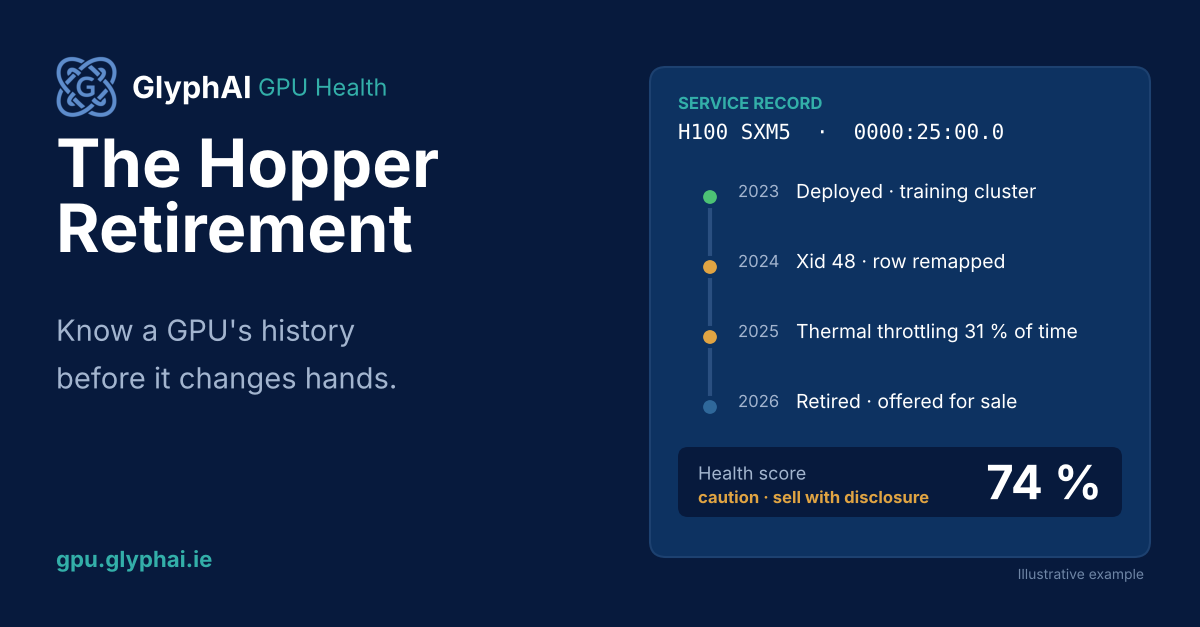
The first Hopper GPUs went into training clusters in 2023. Blackwell has taken over frontier training, and each generation pushes the previous one down a step: from training to inference, then to batch work, then out of the first owner's data centre. A used 8-GPU H100 server already trades at roughly $150,000 to $180,000, against about $500,000 for a new B300 server.
Retirement does not mean the end. It means a sale. And every sale raises the same question: how healthy is this GPU, really?
A market is forming
In July 2026 Compute Exchange opened a secondary market for used H100 and A100 GPUs. Since August, Hashrate Index publishes a price series for refurbished H100 nodes. And condition already moves price: tested, certified H100s sell 15 to 25 percentage points above used ones sold as-is.
The gap: a model number and a burn-in
A buyer usually gets a model number and a burn-in run after delivery. A burn-in shows the card works this week, not what it went through in the three years before. During 54 days of Llama 3 405B training on 16,384 H100s, Meta recorded 148 interruptions caused by faulty GPUs. Two cards that pass the same burn-in can have very different pasts.
The history is already written down
It sits in the server's logs, and disappears when the server is wiped: uncorrectable memory errors and row remapping, spare rows left, bus loss and GSP failures, NVLink and PCIe errors, throttling, failed matrix-math diagnostics. Reading the Dell, Lenovo and HPE message guides end to end showed one more thing: the BMC sees a GPU only coarsely. The faults that set a GPU's value are in the kernel log and DCGM.
A health score for every card
GlyphAI Fleet RCA reads those logs before decommissioning and gives every GPU a score from 0 to 100 %, with every deduction shown. A failed matrix-math test or exhausted spare rows caps a card at 10 %. One uncorrectable memory error caps it at 74 %, caution; a repeat, at 49 %, do not sell.
Stated limits: the score describes history, it is not a forecast; it has been tested on synthetic fleets so far; and a card whose logs were wiped can only be graded by testing.
A short window
The history is readable only until the servers are decommissioned. If you are selling, buying or retiring an H100 or H200 fleet, I will run a free pilot report on one batch in exchange for honest feedback.